"Insights, Reflections, and Lessons from the Frontlines, Intermediates and Beginners in the Venture Capital World."

Tag: personal-finance

  • Death and Taxes!

    Musings of an Intern

    26/02/25

    “There’s only two things certain in this life, death and taxes.” ~ Benjamin Franklin

    Everyday you inadvertently end up paying taxes from GST to Income Taxes to ERP. Have you ever stopped to consider its importance in our society? Well, in its simplest form taxes are a mandatory payment or charge by the various authorities to cover the costs of government activities. But how do governments determine this predisposed tax rate? Lets explore one such theory below.

    Laffer Curve

    First developed by American economist Arthur Laffer in 1974, this curve illustrates the relationship between tax rates and tax revenues collected by governments. The curve suggests that there is an optimal tax rate maximizing revenue and that both 0% and 100% tax rates will result in zero revenue. The curve aims to show that cutting tax rates could lead to increased total revenue due to increased work, output and employment.
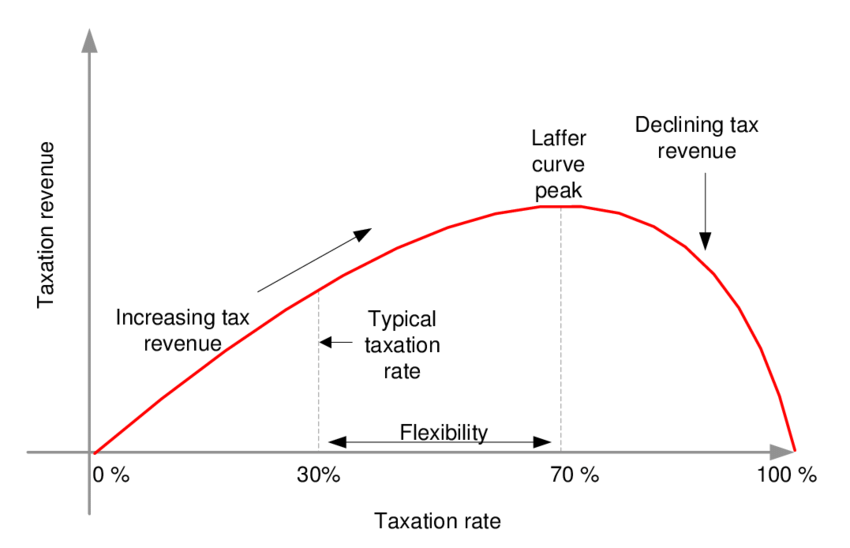
    Fig 1. Laffer Curve maps tax against revenue, peaking where revenue declines, taxation is the average taxation rate from all sources.

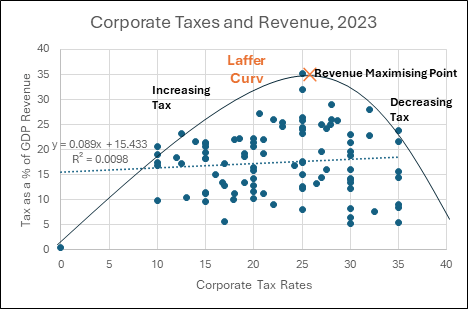
    Well now lets look at a figure I made from comparing taxes as a portion of GDP revenue against the prevailing tax rate in 96 such countries. The low R2 value indicates that tax rates alone explain very little of the variation in tax revenue. Other factors, such as economic size, corporate profit levels, and tax enforcement efficiency, play significant roles.
    There are several other tax theories that economist look at to determine the optimal tax rate. Optimal Income Taxation (Mirrlees Model) , Optimal Commodity Taxation (Ramsey Rule), Capital Income Taxation (Chamley-Judd Result)  and many others. Singapore for example Singapore follows the Chamley-Judd Result which implies that having zero taxes on capital gains ensures long-term economic growth by encouraging capital accumulation and investment and maintain global competitiveness, especially as a financial hub and investment destination. 

    Looking further into Singapore, many multinationals’ corporations (MNCs) operate here and increases in income taxes could lead to wage pull inflation further increasing costs and drive many investors away. Singapore also has a narrow tax pool where the lower income and middle-income residents are hardly taxed, if any at all. Whilst Singapore has increased taxes in recent years, these changes could be taken with a pinch of salt and still allowed for increased in tax revenue without deterring employment and output levels. However, considering that Singapore is often considered a tax haven due to globally low taxes for OCED countries and the vast amount of rich individuals in Singapore where tax revenue is derived from, large increases could lead to very quick dip in the tax revenues. One could also say that Singapore offers vast opportunities and safety that would cause people to stay and given the nature of Singaporeans, its political stability and automated taxes collected, tax evasion would be low and wealthy individuals would remain rooted here.

    Well at the end of the day, these theories can only act as guidelines to nudge each country in the right direction. Economists actually have it hard as it is not easy to derive the actual impact differing tax rates will have on the economy. To apply these and other theories into practice, economists use numerical simulations and calibration methods through computational models to simulate the economy under different tax policies and by adjusting model parameters to match real-world data. However, the only possible way to investigate such changes would be to truly implement them.

    See you next time,
    S!

  • The Three Big Questions That Define Every Investment Fund

    Hey guys, it’s me, the new guy again. Here’s my thought process as of late: Next time if I have a sizeable amount of money, the best way to grow that money is to pay someone to grow it for me (i.e family office funds, private bankers etc.) The 1-2% management fees on top of the slight margin they take on profits is honestly not that bad, considering how much of your time it frees up. But in order to be that rich guy or family, I’m interested in first working for them, being their private banker, being that fund manager, being the one the fund manager turns to for investment decisions or outlooks, you get the gist.

    And so I was researching into funds, its components, various themes, how they perform over time. And that’s where I stumbled across this fascinating discovery: Funds can have values too. And one would think that there are endless possibilities to the types of funds and financial products you can invest in, but I’ve managed to understand how they can be broken down into 3 broad categories, with all funds having 1 trait in each.

    Let’s dive straight into it, before I provide some real-world examples:

    1. Fundamental vs Statistical

    Fundamental funds would involve investing based on one’s understanding of the cause-and-effect linkages that makes up the markets and economics machine, such as looking for undervalued equities, or bonds in regions that are likely to perform well due to its economic performance. On the other hand, statistical funds would mean investing based on statistical relationships that can change rapidly, looking for the best combination of various asset classes to generate the best risk-to-return ratio (Sharpe ratio).

    2. Systematic vs Discretionary

    Systematic investing involves, as its name suggests, a system, with explicit rules defined for investment decisions that can be debated and stress-tested across time, countries and environments, such as using machine learning to analyse historical trends etc.. Discretionary would be investing without explicit criteria that the above has, but it could be something like riding the Gen AI wave, or crypto boom as of recent months. It values recent performances and trends a lot more than historic performances.

    3. Diversified vs Concentrated

    This last category is fairly straightforward, where diversified means your risk is balanced across good, various unrelated return streams to minimize dependency on any given source, such as investing across major markets and asset classes, while concentration would be something like putting all your eggs in one basket – you can either hit the jackpot, or get knocked out of the game if you are wrong.

    Confusing? Here’s some real life portfolio/fund examples that all seem pretty legit, but are made up of different values.

    Example 1: A more classic, textbook fund, where machine learning is used (systematic)to generate trading strategies across 100 different markets (diversified), building a portfolio from these strategies based on the relative weight of each strategy from its historical performance in the last 40 years(statistical). This probably involves a bit of quantitative trading to generate those alphas… an area of potential research.

    Example 2: Holding a portfolio of exclusively US equities and bonds (concentrated). You can determine and change the shares allocated to equities and bonds as well as whether you want to de-risk and change it to cash (discretionary), with these decisions being made based on how well you think the economy will perform (fundamental). If one day the US market crashes because of something Trump announces or war breaking out, this portfolio will just go crashing out… good luck with that. But if not, the last 6months or so have been looking great for the US market, so whoever owns this is probably doing great!

    Example 3: A team of top macro investors identifying their top 10 investments in a given year (discretionary) to build a diversified portfolio of 20-40 positions across various markets (diversified) based on those recommendations. This is likely a fundamental approach to investing in its fund, with no statistical correlations involved at all in the way the fund is structured.

    Learning points and takeaways!

    As you can see all these fund structures out there are all either fundamental/statistical, systematic/discretionary and diversified/concentrated, even though they’re all different but very legit ways of investing in their own right. Not saying there’s a right or wrong though, some funds take on higher risks and in return give higher returns if they “guess” right, while others may be more stable but give you lower returns in a sense. While constructing these portfolios/funds, it is critical to know the investors’ risk appetite and risk preferences, before deciding how to approach the structuring of such funds, to create synergy between the funds and investors’ similar values. As for me, I’ll stick to the GenAI boom for a little while longer. Happy investing everybody! Hope this was as eye-opening for you as it was for me 🙂

    Until next time,

    J

  • Offshore Funds: A Beginner’s Guide

    Musings of an intern

    20/2/25

    Today, the other intern is taking over with a quick dive into offshore funds—what they are, why they exist, and how they work. I’ve always heard about them in documentaries or movies, you know, those “paper companies in the Cayman Islands” that seem super shady. But after spending some time researching them, I can confidently say they’re way more interesting (and less scary) than they sound.

    Why Do Offshore Funds Exist?

    Let’s start with the basics. Offshore funds are essentially investment funds set up in countries outside of where the investors are based. Think Singapore, Dubai, Jersey (the island, not the sweater), or the Cayman Islands. These places are known for their tax-friendly policies, which is the main reason people set up funds there.

    For context, we’re based in Singapore, where the corporate tax rate is a flat 17%. Imagine if your company earns 10 million revenue net of expenses. That’s 1.7 million of your profits going right to taxes! Ouch. But here’s the thing: Singapore doesn’t tax capital gains (profits from selling investments) or impose withholding taxes on dividends paid to foreign investors.

    This means that if investors were to invest 1 million into a fund based in Singapore, and their 1 million grows to 11 million, they don’t pay tax on the extra $10 million when they cash out. Remember, tax is only for profits not capital gains! And if the fund distributes dividends to foreign investors, those aren’t taxed as well. Sounds pretty good, right?

    The Allure of Tax-friendly Jurisdictions

    In fact, many other jurisdictions have low or zero taxes on capital gains, dividends and interest. I was reading about Dubai, with a 0% corporate tax rate in free zones, and Jersey (the country not the sweater), where there is no corporate tax for most businesses, and no withholding tax on dividends as well. As for the Cayman Islands, well they basically have 0 tax at all.

    Layers to Offshore Funds

    Here’s where it gets interesting. Offshore funds often involve layers of companies-yes, companies that own other companies that own other companies. And no, it’s not just for fun. There’s a method to the madness.

    Let’s break it down with an example:

    Main Company: This is the entity that earns income (in whatever form). You set this up in a place with 0% corporate tax, like Dubai.

    Feeder Fund: This is the entity that collects money from investors. You set this up in a place with no capital gains tax, like Singapore.

    Structure: The feeder fund invests in the main company, which earns income (tax-free) and sends profits back to the feeder fund as dividends (also tax-free).

    In this setup, the main company’s income isn’t taxed, and the returns investors get, whether dividends or capital gains, aren’t taxed either. It’s a win-win for everyone involved.

    Why Isn’t This Talked About More?

    Honestly, I have no idea. I used to think that these offshore funds and paper companies were set up for criminal purposes. I was wrong. Offshore funds are a legit way to structure investments, yet they’re often misunderstood or portrayed as shady. The reality is, they’re just a smart way to minimize taxes and maximize returns for investors.

    What I’ve Learned

    The world of offshore funds is vast, and the possibilities for structuring them are endless. From tax optimization to asset protection, there’s a lot to consider. If I ever get bold (or rich) enough to set up a company or fund one day, I’ll definitely think twice about where and how to structure it.

    That’s it for today’s musing! This is my first time writing a blog post ever, but I hope you enjoyed the read!

    Until next time,

    J

    P.S: If you’re a budding entrepreneur or investor, don’t sleep on offshore funds. They might just be the key to unlocking your next big opportunity.

  • Learning From Losses and Gains

    Musings of a VC Founder

    17/12/24

    Dear Diary,

    We often hear investors share stories on how they learnt more from their losses than gains.

    When faced with losses, especially those that were not due to impulse or misinformation, morale of the investor would be absolutely crushed. That is not to say such losses are unavoidable, there must be gaps in the investor’s judgment and cognitive sphere that ultimately led to the misjudgements.  

    Experiencing losses force an investor to rethink and reconstruct his entire cognitive sphere to one that hopefully would prove to be more robust and ultimately more accurate when judging investments.

    The most difficult lesson is perhaps how he would in the face of mounting losses, regain his sense of worth and confidence. Often crushing defeats can annihilate the will to fight on. How do we defend against that and regain our sense of the world?

    Now, lessons are also taken from gains. Such lessons tend to be about confirmation of what works and what doesn’t. These are dangerous lessons; they may lead to confirmation bias getting sunk deep into one’s cognitive sphere and often our most unexpected losses would come from such.

    How do we then meaningfully learn from our Gains? Some would say, deconstruct the entire decision-making processes and look at the variables that led to the outcome. If there are more uncontrollable variables that turned out to be positive which are not backed up by one’s cognitive sphere, perhaps the element of luck from such Gains are significant and perhaps the right lesson would be to learn how better to analyse such uncontrollable variables and risk mitigate against them turning on you.

    To end this reflection I thought it is timely to reflect on two examples of men who learnt from their losses.

    Paul Tudor Jones lost 70% of the monies he managed early on in his career. Such losses would have ended many investment careers.

    Ray Dalio made a wrong market prediction in 1982 leading to him almost going bankrupt and losing the confidence of his investors.

    Both men bounced back and as they say, the rest is history..