"Insights, Reflections, and Lessons from the Frontlines, Intermediates and Beginners in the Venture Capital World."

Tag: entrepreneurship

  • Death and Taxes!

    Musings of an Intern

    26/02/25

    “There’s only two things certain in this life, death and taxes.” ~ Benjamin Franklin

    Everyday you inadvertently end up paying taxes from GST to Income Taxes to ERP. Have you ever stopped to consider its importance in our society? Well, in its simplest form taxes are a mandatory payment or charge by the various authorities to cover the costs of government activities. But how do governments determine this predisposed tax rate? Lets explore one such theory below.

    Laffer Curve

    First developed by American economist Arthur Laffer in 1974, this curve illustrates the relationship between tax rates and tax revenues collected by governments. The curve suggests that there is an optimal tax rate maximizing revenue and that both 0% and 100% tax rates will result in zero revenue. The curve aims to show that cutting tax rates could lead to increased total revenue due to increased work, output and employment.
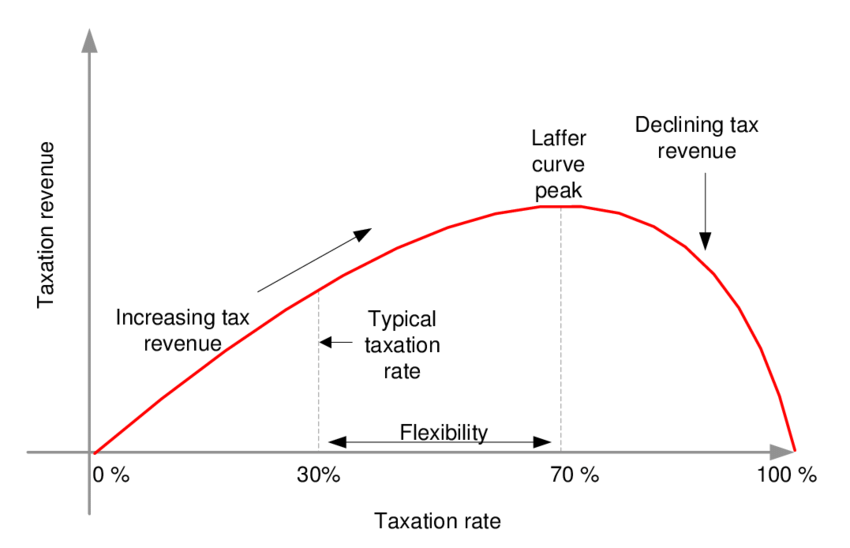
    Fig 1. Laffer Curve maps tax against revenue, peaking where revenue declines, taxation is the average taxation rate from all sources.

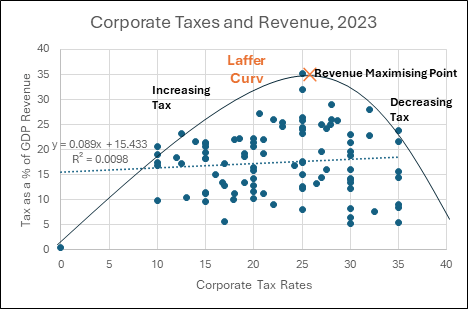
    Well now lets look at a figure I made from comparing taxes as a portion of GDP revenue against the prevailing tax rate in 96 such countries. The low R2 value indicates that tax rates alone explain very little of the variation in tax revenue. Other factors, such as economic size, corporate profit levels, and tax enforcement efficiency, play significant roles.
    There are several other tax theories that economist look at to determine the optimal tax rate. Optimal Income Taxation (Mirrlees Model) , Optimal Commodity Taxation (Ramsey Rule), Capital Income Taxation (Chamley-Judd Result)  and many others. Singapore for example Singapore follows the Chamley-Judd Result which implies that having zero taxes on capital gains ensures long-term economic growth by encouraging capital accumulation and investment and maintain global competitiveness, especially as a financial hub and investment destination. 

    Looking further into Singapore, many multinationals’ corporations (MNCs) operate here and increases in income taxes could lead to wage pull inflation further increasing costs and drive many investors away. Singapore also has a narrow tax pool where the lower income and middle-income residents are hardly taxed, if any at all. Whilst Singapore has increased taxes in recent years, these changes could be taken with a pinch of salt and still allowed for increased in tax revenue without deterring employment and output levels. However, considering that Singapore is often considered a tax haven due to globally low taxes for OCED countries and the vast amount of rich individuals in Singapore where tax revenue is derived from, large increases could lead to very quick dip in the tax revenues. One could also say that Singapore offers vast opportunities and safety that would cause people to stay and given the nature of Singaporeans, its political stability and automated taxes collected, tax evasion would be low and wealthy individuals would remain rooted here.

    Well at the end of the day, these theories can only act as guidelines to nudge each country in the right direction. Economists actually have it hard as it is not easy to derive the actual impact differing tax rates will have on the economy. To apply these and other theories into practice, economists use numerical simulations and calibration methods through computational models to simulate the economy under different tax policies and by adjusting model parameters to match real-world data. However, the only possible way to investigate such changes would be to truly implement them.

    See you next time,
    S!

  • Discounted Cash Flows

    Musings of a VC Intern

    18/02/2025

    DCFs, NPV, LBO, EBITDA and so many more finance terms are thrown around daily here and there.

    Today let’s delve into DCFs first. Discounted Cash Flow is a financial model that helps evaluate how much a company will be worth in the future or its NPV by analyzing financial statements. There are often key assumptions in place such as growth potentials and expenses. A financial model is never accurate but they are there as a metric to roughly gauge how much our company can be worth in the future. Often this is done by analyzing at least the past three years and estimating growth rates. By determining this values we can arrive at a terminal value. This terminal value is the price which the company will be worth in the future by x number of years. Depending on the value of this terminal value people will evaluate whether it is a worthwhile investment.

    We then talk about WACC, weighted average cost of capital. This is the weighting of future costs and benefits to reflect the time value of money. This is because money decreases in value due to inflation, we also have to consider interest rates if we borrowed said money to invest in the company and grow it. Assuming an interest rate of 4% and an inflation rate of 3%, our WACC is 7.12% per year. Lets say this spans a 5 year period, our net present value based on the DCF would have to be a minimum of 41.04% larger than the initial capital before we can consider the investment even profitable.

    Furthermore private equity investors would look for higher returns. Assuming we negate the interest rates because these people invested money in us so we dont technically owe them, and also the inflation rate is not accounted for as they will be wanting to see value of the investment against other companies or for example SnP500. So lets say a return of at least 15% per annum. Thus, we would have to return 101.2% larger than the initial investment for them to consider an investment.

    There are also dividends we can consider into play. Assuming we give out 1% as dividends per annum and they want a 10% return rate. Now you try and do the math this time.

    So every year the discount factor will change because it is further from your present and the value of that money will drop in a discounting manner. By estimating these cashflows using the potential discount rate, we can derive how much capital we can gain each year from the investments in net present value terms.

    But wait if the company has a steady income and growth potential can’t you sell it off for more money? Exactly, that is where terminal value comes into play. There will be a sensitive factor known as your growth rate in growing perpetuity. You can take a rate of let’s say 5% a year. Or you can evaluate it using Enterprise Value (EV) multiples, which essentially shows you how much other companies similar to your own is worth. Often times this is very industry centric and will sway largely accordingly. With that, now we can value our company accordingly.

  • An Intern’s Predictions

    Musings of an Intern

    10/12/24

    Dear Diary,

    Markets are changing and it’s a scary time ahead… The world is full of uncertainty and volatility and I am not sure what to think of it. With the new US President elected, the abrupt martial law in South Korea, Japan ending its eight year period of negative interest rates and many more globally stimulating events.

    But it’s not all bad. Despite this volatility, there is a positive economic outlook and although growth may slow, growth is growth. Like I was reading on some of the new incoming policy changes in the US like increasing tariffs and tighter immigration. I really think they are set to affect imports and exports globally and hinder demand whilst increasing inflation. It may just become a heaty season for the prices in the products market. Hopefully though, Trump’s policies on lower taxes and deregulation could also cause a bull market as we have seen amongst cryptocurrencies and stocks since he has been elected into the office. I am really praying man, I am trying to 10x my money. ($cha-ching$)

    Although strategists have found it difficult to formulate future outlooks, many have hinted to average returns of around 10% growth in the stocks market in 2025, making it an average year for markets. Long term outlooks have been hopeful and profit margins are expected to rise as operational efficiencies have not been realized since the pandemic. With many offices still yet to return to work 5 days a week, growing innovation and technology, strategic layoffs, and, improving manpower efficiency, we could see a massive growth market. Earnings growth is also as such expected to widen out away from the “great seven” of the S&P 500 this year. So, this time around I am going to diversify and multiply and hope for the best.

    Price ratios are also at all time highs and these high valuations could cause the market to cool off and demand to see actual earnings potentials in the coming years if one were to expect parabolic growth of stocks. Regardless, with a strong momentum and easing of monetary policies by central banks and strong innovation in all fronts of R&D, let’s kick back, sip our cha, dip our biscuits and hope for the best. In the coming years we could be seeing generative AI blow up and develop in the market aggressively and push for cross border collaborations strengthening technology on all foregrounds and improving our daily lives. So my dearest diary, I am really quite excited for the new year.

  • The Digital “Gold Rush”!

    Musings of an Intern

    28/11/24

    Dear Diary,

    I was up all night yesterday, mesmerized by all the various memecoins. Seriously….what is this “ChillGuy” token? Market Cap of 435 MILLION dollars with a equally large trading volume in the past 24 hours. What’s more is that in the past 5 days, the coin went up 266,000%. I could have been a millionaire, instead I was busy watching the new season of Outer Banks on Netflix.

    Like don’t get me wrong, I am not a complete newbie to all these digital coins. I have been dipping my fingers into some of these virtual pools and picking up some of them to keep for myself. These decentralised virtual assets have been wrecking a chaos on me though. From the Sam-Bankman Fried scandal causing the FTX crash to Chinese and American crypto “whales” that move markets in seconds. Price manipulations are occurring left and right, and I am the small fish left there to drown. Crypto is such a gamble, do I really want to take this risk…

    Cryptocurrencies and memecoins have also gained so much traction since the recent elections and there are overnight millionaires being made regularly. There is so much money to be earned in this ecosystem, billions upon billions are being poured in and I think despite the risks there is much to be gained.  I mean how is that in our reality the 7th largest cryptocurrency is a memecoin called DOGE. The community of memecoins is a volatile yet passionate one. Whilst Bitcoin or Ethereum, were created with an actual financial utility in mind, memecoins are made cheaply and often marketed and the communities are fostered in order to grow and manipulate its value.  The beloved DOGE coin for example is mentioned in high frequency by Elon Musk, the richest man of today, boosting its value tremendously. Other memecoins like “ChillGuy” or “Grumpy Cat” are simply a marketing wonder, tapping into the absurdity of the internet’s meme culture. Often times, it is an inside joke from Tik Tok or Reddit, and the more you’re in on it, the more likely you are to toss in a couple of bucks to see if it pays off. The meme economy is a real thing.

    So with all these thinking and going back and forth on this today, I have decided maybe I will gamble off my money sometimes but not much. I will skip a Starbucks drink here and there, maybe I will get lucky or maybe I will laugh at myself. Most importantly I will keep a balance, try not to get caught up in making a quick buck and stay in the loop. One of these nights I will hop on a discord call with my friends, grab some popcorn, open tabs for DexScreener, Reddit, Twitter, Phantom, and Telegram, while saying ” xxx to the MOONN!” But tonight, I will just get all snugly and watch my Outer Banks on Netflix.

  • The Origin

    Musings of a VC founder

    28/11/2024

    Dear Diary,

    It is one of those countless sleepless night I am having since the founding of our firm. While we are never in better shape than now, I still feel the “slaps on my face” when we get rejections from co-investment schemes (to be fair, we do not have a lot of dry powder at the moment), getting snide remarks as an “investment club” that is not serious and doing things for fun (what?!) and ultimately paled in comparison to our monied peers who caught the rising wave of the industry earlier and had their representative investment successes through the rise of regional unicorns.

    We entered into the fifth year since the founding of our firm. While we projected this year to be the year where our fund management firm’s revenue (not inclusive of carry) would finally match our expenses, we still missed our target, albeit, we remain healthily cash flow positive.

    The founding team came from the same department in the same organisation within the leading IHL in Singapore. We are very different individuals. “One is a veteran in the scene, with more than 19 years of experience under his belt (now 24 years), seen the nascent growth of a fledgling VC industry took shape and was instrumental in mentoring some of the household names among startups in Singapore and the region. “Two came with corporate restructuring (as a lawyer and while working in a listco), general corporate management (at a listco), corporate finance (in private equity), fund management (private equity) and lawyering background who had at one point provided legal services to 30-40% of the VC fund management firms in the region. “Three came equipped with engineering optimisation background, armed with a systematic approach to dissecting various aspects of businesses to optimise for results. “Four came with a reputation of being everybody’s friend, likeable and agreeable in every way and had some years of VC fund investing and startup mentoring exposure through shadowing his father’s work as a LP in a famed VC Fund of Funds.

    As active participants in the startup scene, our team has witnessed improbable startup miracles and have seen our fair share of startups with great promises crumbled. We thought we know something about picking the right horses, perhaps we really do, since our team’s track record prior to founding our own firm stands at 50% success rate for seed stage startups and more than 75% success rate for startups raising Series A and above. Our secret sauces: (1) “It takes a village to raise a child approach” where we find many industry friends and supporters to provide market access, first contracts and sometimes even key hires to the startups; and (2) building trust and rapport with founders so that we could make critical intervention when required through the help of our industry network. 

    We started our VC firm thinking we could translate the goodwill and relationships we had cultivated with investors and various institutions from our respective work stints at an IHL in Singapore focusing on nurturing and investing in startups. We couldn’t be more wrong.

    Weeks before COVID-19 took the world by storm, we resigned from the comforts of our beloved workplace where many memories were forged, where we soldiered on, fighting the good fight among many student entrepreneurs. In a little badly lit dingy little office room we set up base at (Midview City), we received news on all US$15M pre-commitment pulled out from the fund just before we entered into lockdown in Singapore. To be fair, such commitments were secured too quickly (a little too fast to be true?), i.e. through 2 trips made by “Two” to link up with his monied friends from China and Hong Kong with term sheets signed. Worst, our landlord sold his office unit and we had 1 week to vacate the room.

    Most among us were ready to throw in the towel and call it a day. “Two’s” career has been riddled with obstacles and near impossible challenges throughout and thought such setbacks are only normal and more will come. He encouraged and probably some would say, coaxed everyone to forge on. (to be continued…)